Why a Shadow Has a Soft Edge
Why a shadow has a soft edge depends on the light source and its spacing from an object. Learn to adjust both for a crisp or gradual boundary.
Why a shadow has a soft edge comes down to the light source and the gap between the object and the surface. Hold a mug between a small torch and a wall, and its outline may look crisp; illuminate it with a broad window, and the boundary is likely to spread into a gradual band.
Shadow zones
A shadow is where an object blocks some or all of the light travelling towards a surface. In the darkest central region, called the umbra, the object hides the entire source. Around it is the penumbra, where the object blocks only part of the source. Beyond the penumbra, the surface receives light from the whole source.
An ideal point source sends light from a single location, producing a sharp boundary between full light and full shadow. Real lamps, windows and the sun occupy an apparent area. Their different parts send light along slightly different paths, so some paths are blocked near the shadow’s edge while others remain open. That partial blocking creates the penumbra.
The source’s apparent size is the angle it occupies from the object, not just its physical dimensions. A large softbox viewed from far away may appear smaller than a modest lamp placed close by. Apparent size and the distances between source, object and surface together affect how wide the penumbra looks.
Small or distant sources
A small source, or one far enough away to appear small, usually produces a narrow penumbra. This can give a pencil’s shadow on a wall a defined outline. The transition can still broaden if the object is far from the receiving surface, but it is generally narrower than the one made by a broad source in a similar arrangement.
Spacing matters because light from different parts of the source reaches the surface at different angles. When the object sits close to the surface, those paths pass around it over a short gap, so the edge tends to be tight. Increase the gap and the paths spread the transition across a wider strip.
Moving a small lamp closer makes it appear larger and tends to soften the edge. Moving the object towards the wall tends to sharpen it. These adjustments can work against each other, so change one at a time if you want to see which is affecting the boundary.
Broad nearby sources
A broad, nearby source sends light towards the object from a wider range of directions. More parts of the source are blocked at the shadow’s edge, widening the penumbra. A large window, an overcast patch of sky or a diffused studio softbox can all create a gradual transition.
A broad source does not remove the shadow; it spreads the partially shaded area. This can make an outline less conspicuous in a portrait or still-life arrangement, where a hard boundary might distract from the subject.
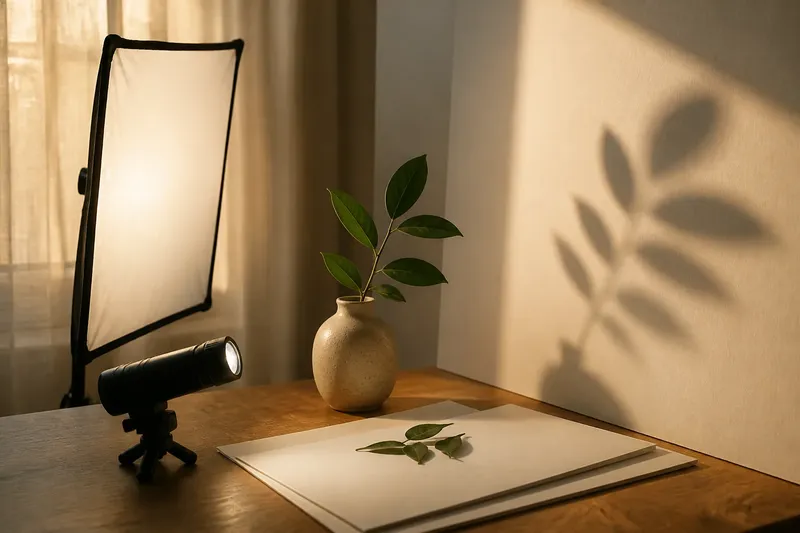
Imagine an invented situation: you want to see how a leaf’s shadow falls on white card. You place a small torch well back, with the leaf between it and the card, and see a narrow edge. Keeping the leaf and card in place, you replace the torch with a nearby diffused panel; the expected result is a broader, softer boundary. You then move the leaf closer to the card, leaving the panel where it is; the transition should tighten. The sequence shows how source size and object-to-surface spacing can push the edge in opposite directions.
Shadow edge questions?
What makes a shadow edge soft?
A source with greater apparent size creates a broader penumbra because its parts reach the surface from more directions. The gap between object and surface matters too, so source size alone does not determine the edge.
Does moving the light change softness?
Yes. Bringing a source closer makes it appear larger from the object’s position, which commonly softens the boundary. Moving it farther away makes it appear smaller, although changing the object’s position can affect the result too.
Why does a shadow have a soft edge outdoors?
In direct sunshine, the sun acts as a source with a small but non-zero apparent size, leaving a narrow penumbra. Cloud cover scatters sunlight across a broader area of sky, often making the transition more gradual.
How can I make a shadow sharper?
Choose a source that appears small from the object and bring the object nearer to the receiving surface. A bare torch is useful for a quick comparison; a diffused lamp or large window is better suited to softer transitions.
Choose the arrangement
Use the edge you want to guide the setup, then adjust one relationship at a time. For a defined outline, try a small torch or a distant bare lamp and place the object near the wall or card. For a gradual edge, use a broad window, diffused panel or lamp with a large diffuser, and leave more space between object and surface.
- Check whether the source appears small from the object; if it does, expect a tighter edge, and if it does not, move it farther away or use a smaller source.
- Check whether the source is broad or diffused; if it is, expect a wider transition, and if you want a sharper outline, switch to a bare torch or another smaller-looking source.
- Check whether the object is close to the receiving surface; if it is, expect a tighter edge, and if you want a broader transition, increase the gap.
- Check whether the object is far from the surface; if it is, expect a wider transition, and if you want a sharper edge, bring it nearer.
- Check whether the surface and object stay in the same positions while you compare lamps; if they do, the source is the main changed factor, and if they do not, return them to their original positions before comparing.
- Check whether the lamp has a diffuser or placement instructions; if it does, follow them, and if the setup would require altering the equipment, choose a different arrangement instead.
Keep the receiving surface fixed while comparing sources, then keep the source fixed while moving the object towards or away from the surface. This makes it easier to identify which adjustment widened or narrowed the penumbra. Follow the lamp’s instructions rather than modifying the equipment.
A shadow’s apparent softness can vary along its outline. A curved object may sit at different distances from the surface at different points, making one section crisp and another more gradual. That variation reveals how the object, light and surface are arranged.
To judge why a shadow has a soft edge, first look at how large the source appears from the object, then at the gap between object and surface. Those two observations help you choose between a crisp silhouette and a gentler transition, according to the result you want.