How a Camera Obscura Turns a Room into a Camera
Learn how a camera obscura turns a darkened room into a camera, why its projected scene appears inverted, and what makes the image clearer to see.
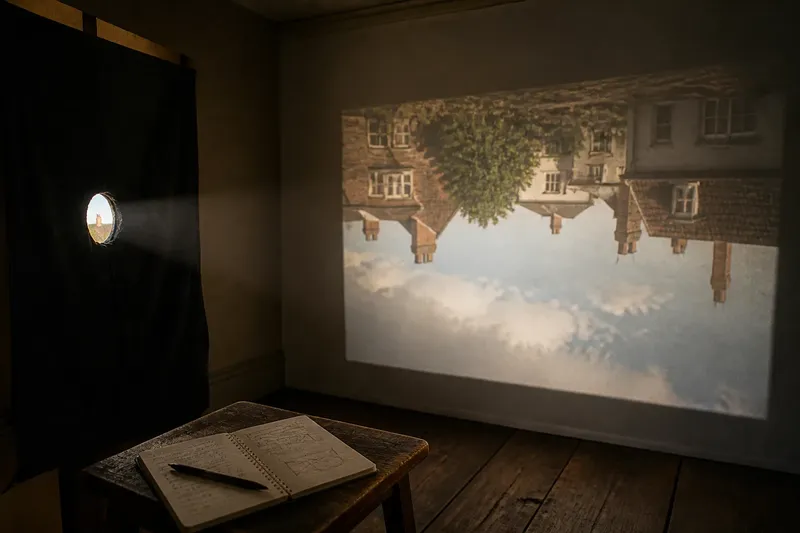
How does a room become a camera? In a camera obscura, a small opening admits light from an outdoor scene into a darkened space, where the rays form an image on the opposite wall. The room does not record or store that image; it acts as a large camera body, with its walls excluding stray light and one surface serving as a screen.
The name means “dark room”. It describes both the optical effect and the enclosed space that makes it visible. Long before photography could preserve an image, a camera obscura let people inspect a temporary projection formed by light passing through an opening.
The room as camera
Imagine a bright outdoor view beyond one wall of a dark room. A small hole in that wall admits light. On the opposite wall, a patch of the scene appears: perhaps a roofline, a tree or the bright shape of a cloud.
The room functions as a camera because it controls where light can enter. Its dark interior limits competing illumination, the aperture admits a restricted set of rays, and the far wall receives their pattern. Unlike a mirror, which reflects light towards an observer, the camera obscura projects light directly onto a surface.
A light-tight box can make the same effect on a smaller scale. In either form, the essential parts are an enclosed dark space, an opening and a surface on which to see the projection. The room is not simply a place where an image happens to appear: its enclosure and opening organise the light.
Why the image is inverted
Light travels in straight lines through air. Rays from the top of an outdoor scene approach the aperture from above; rays from the bottom approach from below. Once they pass through the small opening, they cross: light from the top reaches a lower part of the opposite wall, while light from the bottom reaches a higher part.
The same crossing occurs from left to right. Light from the left side of the view lands on the right side of the screen, and light from the right lands on the left. The image is therefore inverted vertically and reversed horizontally. The room does not rotate the scene; the reversal follows from the paths of rays through one restricted opening.
Each visible point in the outside scene sends light in many directions. Some of those rays pass through the aperture and reach a particular area of the screen. Rays from other points reach other areas, so their combined pattern reproduces the arrangement of the scene in light and shade.
Camera obscura image clarity
The size of the opening affects both brightness and detail. A broad aperture lets in more light, but rays from each point arrive along a wider range of paths and spread across the screen. They overlap with rays from neighbouring points, softening outlines. A smaller aperture narrows those paths and can sharpen the image, but also makes it dimmer.
The smallest possible hole is not automatically best. If an aperture is extremely small, light waves spread around its edges and can soften the projection. In a room demonstration, a more immediate limitation may be that too little light enters for comfortable viewing. The useful opening balances visible brightness with recognisable detail.
The screen also matters. A pale, reasonably smooth wall or sheet scatters arriving light towards the viewer. A dark surface absorbs more of it, while a glossy surface may reflect it away or produce distracting glare. The screen does not create the image; it makes the arriving light easier to see.
What changes the projection
The positions of the scene, opening and screen affect the projection. A distant landscape may fit on the screen, while nearby objects can appear large or fall outside its edges. Moving the screen farther from the aperture can make the image larger, but the light spreads over a broader area and the projection may look dimmer.
Stray light reduces contrast. If light leaks around a curtain or door, the room’s general brightness rises and the projected shapes become harder to distinguish. A bright outdoor scene and a well-darkened interior make the image easier to inspect.
Colour comes from the light reaching the screen. A red roof sends red-looking light through the opening, while a nearby blue area sends light that appears blue. In a faint projection, colours may seem muted and fine detail can disappear first. The image is shaped by the light available, rather than being an evenly lit copy of the scene.
How does the camera obscura work?
Does a camera obscura need a lens?
No. A small aperture alone can form an image by restricting the directions from which light reaches each part of the screen. A lens can gather more light and help bring rays to a focused image, but it is not needed for the basic effect.
Why is the projection faint?
Only a small portion of the light from the outdoor scene passes through the aperture, so the screen receives less light than the scene itself. Darkening the room and choosing a bright view outside can make the projection easier to see.
Can a camera obscura show an upright image?
With one simple opening, the image is inverted. A mirror or prism can redirect the light and alter its orientation, but the result depends on how that optical element is positioned.
Can a camera obscura work outdoors?
Yes, if the viewing area is enclosed or shaded enough to keep stray light from washing out the projection. A portable box or tent can provide the dark space instead of a whole room.
A room-scale demonstration
Say you have a room with a window facing a row of rooftops. Cover the window with an opaque sheet, leaving a small opening, darken the room, and place a pale sheet of paper on the opposite wall. The expected result is an upside-down projection of the rooftops. If it looks washed out, check for light leaking around the sheet; if it is too dim, a slightly wider opening may brighten it, though the outlines may become softer.
Changing one feature at a time helps make the room’s role visible. Widening the opening can increase brightness while reducing detail; moving the screen changes the image’s scale and can spread its light. The room becomes an instrument for inspecting how light travels, rather than just a container for the projection.
Projection and photography
A camera obscura produces a visible image, but the image does not remain once the light is gone. Photography adds a light-sensitive material or electronic sensor to record the incoming pattern. A modern camera still uses an enclosed body, but commonly adds a lens to gather light and focus it on an image plane.
The distinction is between projection and recording. The room becomes a camera in the optical sense: its dark enclosure controls stray light, its opening admits rays from the scene, and its wall receives their image. That image is temporary, but it makes the geometry of light visible without preserving it.