Matte or Glossy: Two Ways a Surface Sends Light Back
Matte or glossy surface reflection shapes where brightness appears. Learn to read highlights and choose a finish that feels comfortable in your room.
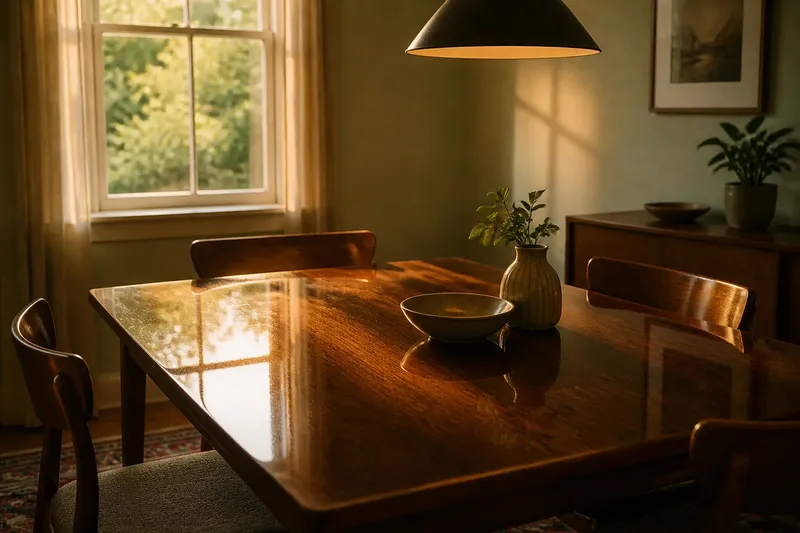
Why does a matte wall look evenly lit while a polished tabletop catches a bright patch from the same window? Matte or glossy surface reflection sends light back in different patterns: one spreads it across many directions, while the other forms a more concentrated reflection. Watching where the brightness goes makes the difference easier to recognise.
Two reflection patterns
When light reaches a surface, some of it returns towards the room. The pattern depends partly on the surface’s tiny ridges and hollows. These irregularities may be too small to see individually, yet they change the directions in which the light leaves.
A matte finish has many differently angled microscopic features. Light arriving from a lamp or window is scattered across a broad range of directions. This is diffuse reflection. The surface can appear bright from several positions, but it does not usually show a sharp image of the light source.
A polished, glossy finish is smoother at that microscopic scale. Its reflected light remains concentrated in a narrower direction, like a blurred or clear reflection in a mirror. This is specular reflection. The smoother the finish, the more recognisable the reflected source or nearby shapes may be.
Most everyday materials sit somewhere between these descriptions. A satin-painted door, a glazed tile and a varnished wooden table can all return a mixture of scattered light and more organised highlights. “Matte” and “glossy” describe a tendency, not two perfectly separate kinds of material.
Where brightness appears
Stand beside a painted wall and move a little to one side. Its general brightness may remain fairly even because diffuse reflection sends light towards many viewing positions. The wall’s texture and the direction of the original light still matter, but a strong, crisp image of a window is unlikely.
Now look across a polished table. A window may appear as a bright shape on its surface, and that shape can slide or vanish as you change your position. The table has not moved; the viewing angle has changed the route by which reflected light reaches your eyes. This is why a glossy finish can seem calm from one seat and dazzling from another.
For a simple observation, use a desk lamp and a book with a matte cover alongside a glazed ceramic plate. Keep the lamp in one place, then look from several angles. The book should show a broad change in brightness, while the plate is more likely to show a concentrated highlight that shifts with your viewpoint. The exact appearance depends on the objects’ finish and shape.
Reading a highlight
A highlight is a brighter area where reflected light reaches your eyes more strongly than nearby light from the surface. Its position and shape can help you tell whether a material spreads light broadly or returns it in a more organised direction.
Why does a glossy reflection move?
A glossy surface reflects light most strongly in directions set by the incoming light and the surface angle. Moving your head changes whether that reflected path points towards your eyes, so a highlight can travel across the object or disappear.
Can a matte surface still glare?
Yes. Matte finishes scatter light broadly, but a bright source can still make them uncomfortable to look at, especially if it is in the field of view. The glare is usually less like a crisp reflected image and more like a spread of brightness.
Does glossy always mean a clearer reflection?
No. Surface smoothness helps, but a curved shape, scratches, dust or an uneven coating can distort the reflected image. A glossy object may show a bright patch without showing a recognisable scene.
Why can a polished table look darker?
From some positions, the table may reflect a dim part of the room rather than the window or lamp. Its apparent brightness can therefore change sharply with viewpoint, even though the material and room lighting stay the same.
Choosing a finish
For a wall, a matte finish can make reflected light feel more evenly distributed and can avoid distinct window images. A glossy surface can add visible highlights and make shapes in the room appear on the surface itself. Neither effect is automatically better; the useful question is what you want the surface to show.
On a tabletop, consider where people sit and where bright windows or lamps fall. If a reflection lands in someone’s usual line of sight, changing the lamp position or choosing a less reflective finish may make the surface more comfortable to use. If you want a polished look, viewing the material from the room’s actual angles helps reveal where its highlights will appear.
Labels such as eggshell, satin and semi-gloss are not used identically by every maker, so check the product description and follow the manufacturer’s instructions when choosing or applying a finish.
Imagine a dining table with a polished top, a pendant lamp above it and a chair where the reflection falls directly into a seated person’s eyes. The household shifts the lamp to one side, then checks the tabletop from that chair and the others around it. If the bright patch now falls away from those sightlines, the adjustment has improved comfort; if it still catches someone’s eyes, the household can try a different lamp position or consider a less reflective surface. The trade-off is that moving the lamp changes where its light falls in the room as well as where its reflection appears.
Surface clues
- Look for an image: If you can recognise a window or lamp, the reflection is relatively organised; if not, compare the spread of brightness instead.
- Change your viewpoint: If a bright patch shifts as you move, it is a useful clue to glossy reflection; if it stays broad and even, look for diffuse reflection rather than a distinct highlight.
- Compare broad brightness: If the surface looks similarly lit from several positions, it is scattering light widely; if the brightness changes sharply, check whether the view now includes a different reflected part of the room.
- Check the shape: If a curved or uneven object stretches or breaks the reflection, judge the surface from another angle; if the image remains distorted, do not use image clarity alone to classify its finish.
- Notice the surroundings: If a polished surface looks dark, check whether it reflects dark furniture; if a bright window is reflected instead, compare its appearance from another position.
- Check the viewing position: If a highlight falls in a usual seat’s line of sight, try shifting the light source and checking again; if it remains distracting, consider a less reflective finish.
These observations make “matte or glossy” less about a label and more about the light pattern a surface returns. For matte or glossy surface reflection, shift your position and watch where the bright patch goes: its movement can reveal how the surface handles light more plainly than its product name does.