A Window-Sill Study for a Changing Afternoon
A window-sill study for a changing afternoon helps you track a daylight patch’s position, shape and colour with clear notes and a simple room sketch.
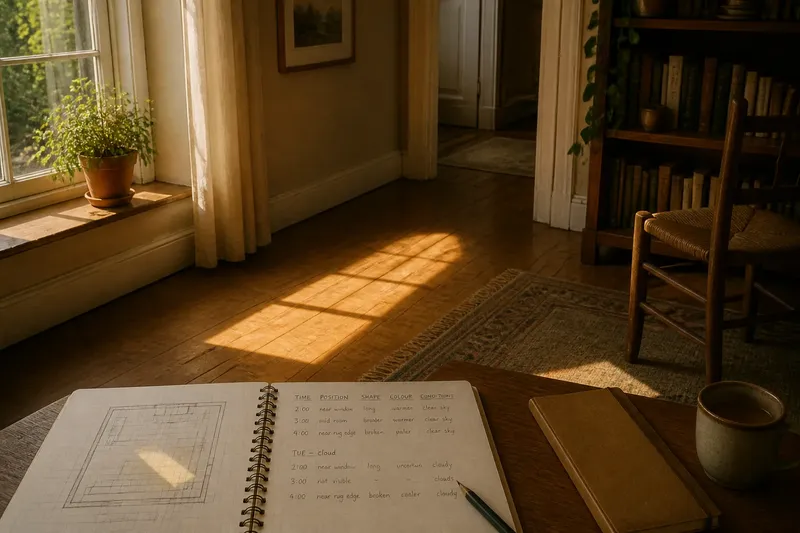
Where does a bright patch on the floor move as afternoon passes, and how does its colour seem to change? A window-sill study for a changing afternoon gives you a simple way to track daylight in one room using a notebook, a pencil and familiar landmarks.
The aim is to make a repeatable record, not a precise scientific measurement. Choose one patch you can see from the same place, then note where it falls, how its outline changes and how nearby surfaces appear under its light.
Choose a viewing place
Pick a spot where you can see the window and the patch without moving furniture. A chair near the doorway or a place beside the window-sill may work. Keep your viewpoint consistent: moving even a little can change the patch’s apparent shape and position.
Choose one recognisable area, such as sunlight on a wooden floor or a bright shape on a rug. Avoid moving objects in and out of it during the study. If the patch disappears behind a curtain, moves out of view or is absent on a cloudy afternoon, record that rather than switching to another patch.
Gather a notebook, a pencil and, if useful, a simple sketch of the room. A phone can help you check the time, but photographs are optional. If you take them, keep the camera in the same place and remember that its automatic colour and brightness adjustments may not match what your eyes see.
Set a simple routine
Follow the same afternoon period over several days in one week. Choose observation times that fit your schedule, such as early, middle and later afternoon. Use roughly the same times each day so that your notes are easier to compare.
At each visit, pause in your chosen viewing place and record these observations:
- Position: Note whether the patch is near the window, farther into the room or outside your view. If it is visible, mark its location on your sketch; if not, write “not visible” and do not estimate.
- Direction: Name the fixed feature it approaches or leaves, such as a table leg, skirting board or rug edge. If no landmark is nearby, mark the patch’s approximate boundary on the sketch instead.
- Shape: Describe it as long, narrow, broad or broken by a frame or curtain. If the edge is too faint to distinguish, record that uncertainty rather than drawing a firm outline.
- Colour: Note whether the illuminated area looks warmer, cooler or hard to distinguish from the room’s usual light. If the difference is unclear, write “uncertain” rather than choosing a colour impression.
- Room conditions: Note clouds, a lowered blind, an open door or a switched-on lamp. If one of these changes during the week, keep it in the notes; if conditions remain unchanged, mark them as unchanged.
Describe what you see before suggesting why it happened. “The bright edge has passed the chair” is an observation; “the sun is lower” is an interpretation. Keep a possible explanation in a separate note so the two remain distinct.
Use fixed references
Fixed features give your notes a shared scale. Instead of estimating distance, write that the patch has reached the near edge of the rug or crossed a particular floorboard. If the floor has no obvious markings, make a quick sketch and mark the approximate boundary.
For colour, compare the illuminated area with a nearby part of the same surface that remains outside the direct light. Note whether the patch looks yellower, paler or more saturated. A white sheet of paper can also be a comparison object if it stays in place, but its appearance changes with the surrounding light too.
Keep changes in the room’s lighting in view. A lamp, blind or open door can alter what reaches the floor. Record the change alongside your observation instead of treating it as an error to remove.
When the afternoon differs?
What if the patch disappears?
Write “not visible” and note whether clouds, a closed blind or movement beyond your view might explain its absence. Do not fill the gap with an estimate; the interruption is part of the record.
Should I use a phone camera?
A photograph can help you compare a patch’s outline and position if you keep the phone in one place. Automatic exposure and colour adjustments can alter the image, so pair it with a short description of what you saw directly.
What should I do on a cloudy day?
Record whether the patch is faint, diffuse or missing, and describe the room’s overall brightness in ordinary terms. If clouds soften the distinction between direct sunlight and the rest of the room, note that change rather than trying to infer the patch’s usual position.
How can I compare different days?
Place each day’s notes beside the same room sketch and compare matching observation times first. Look for recurring patterns, while remembering that a single week does not describe every season.
Read the week’s pattern
At the end of the week, compare entries made at similar times. Look for repeated changes in position or shape, then check whether weather or room conditions offer a possible explanation. Treat the pattern as a description of this room during this week, not as a rule for daylight everywhere.
Say you choose a patch beside a bookcase and make three observations each afternoon: early, middle and later. On the first afternoon, you mark it beside the skirting board early on and across a floorboard later; the middle position falls between those landmarks. On the next afternoon, clouds hide the patch at the middle observation, so you write “not visible” and note the cloudy sky. Comparing the sketches shows the route on the first day, while the written note preserves the interruption on the second. The record does not imply a continuous path where you could not see one.
If you repeat the window-sill study for a changing afternoon in another season, keep the viewing place and landmarks where possible, but start a fresh page. The same reference points make the new notes easier to compare, while a clear note of changed room conditions helps explain why the daylight may look different.